Wednesday, 1 November 2017

Origin of the power of quantum computing

Predicting the behavior of many particle quantum system requires solving the Schrödinger equation for a wavefunction that has complex dimensionality proportinal to the number of particles. Such a wavefunctions contains a value for all possible combinations of particle positions, i.e. it describes a kind of "multiverse" where everything conceivable happens simultaneously.


The system evolves as a whole and thus in order to predict phenomena such as entanglement, it is necessary to solve the time evolution of the "multiverse" rather than time evolution of separate wavefunctions corresponding to single particles. Single separate wavefunctions cannot yield predictions corresponding to observations in every circumstance.
The power of quantum computing is based on the complexity of the time evolution of this kind of multiparticle wavefunction. The classical computational resources required to do full simulations scale extremely poorly, but it is possible to demonstrate the idea with a simple code (below).

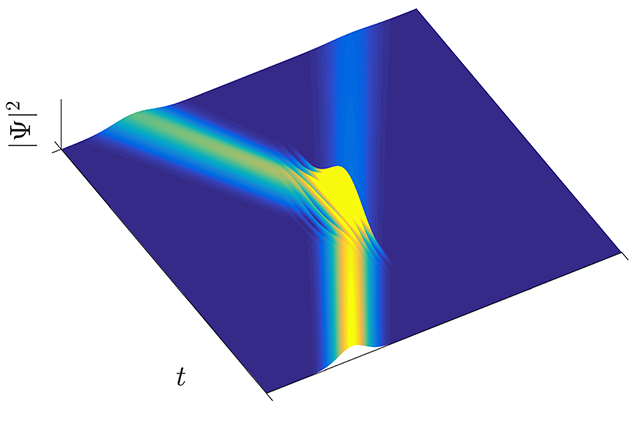
Full simulation of the time evolution of three electrons starting at rest relative to each other. Variable containing the wavefunction is a 6D grid of 26 complex points (3D double complex 26x26) and requires about 2.3 GBs of memory. Adding one more particle would make it 8D and require about 1556 GBs of memory. Simulating 30 particles in this configuration would require more bytes of memory than there are atoms in the observable universe. Many problems can be approximated effectively without conducting such simulations, but there are a few cases like quantum computers which cannot. Qubit are typically in a simple static grid rather than free space such as electrons in this simulation so larger number of qubits can still be simulated. The point at which quantum computers are expected to become more powerful than classical supercomputers (so called quantum supremacy) is a the moment 56 qubits.
n = 0.05;
N = 26;
x10 = -0.4; y10 =  0.4; vx1 = 0; vy1 = 0;
x20 =  0.4; y20 =  0.4; vx2 = 0; vy2 = 0;
x30 =  0.0; y30 = -0.4; vx3 = 0; vy3 = 0;
frequency_spread = 40;
psi = zeros(N, N, N, N, N, N, 'single');
V = zeros(N, N, N, N, N, N, 'single');
S = linspace(-1.0, 1.0, N);
for y1 = 1:N
    for x1 = 1:N
        for y2 = 1:N
            for x2 = 1:N
                for y3 = 1:N
                    for x3 = 1:N
                        envelope = exp(-frequency_spread*((S(x1)+x10)^2 + (S(y1)+y10)^2 + ...
                                                          (S(x2)+x20)^2 + (S(y2)+y20)^2 + ...
                                                          (S(x3)+x30)^2 + (S(y3)+y30)^2));
                        velocity = exp(-j*(vx1*S(x1) + vy1*S(y1) + ...
                                           vx2*S(x2) + vy2*S(y2) + ...
                                           vx3*S(x3) + vy3*S(y3)));
                        psi(x1, y1, x2, y2, x3, y3) =  envelope.*velocity;
                        V(x1, y1, x2, y2, x3, y3) = 1/sqrt(n + (S(x1)-S(x2))^2 + ...
                                                               (S(y1)-S(y2))^2)^2 + ...
                                                    1/sqrt(n + (S(x1)-S(x3))^2 + ...
                                                               (S(y1)-S(y3))^2)^2 + ...
                                                    1/sqrt(n + (S(x2)-S(x3))^2 + ...
                                                               (S(y2)-S(y3))^2)^2;
                    end
                end
            end
        end
    end
end
for t = 1:500
    PSI1 = squeeze(mean(mean(mean(mean(psi, 1), 2), 3), 4));
    PSI2 = squeeze(mean(mean(mean(mean(psi, 1), 2), 5), 6));
    PSI3 = squeeze(mean(mean(mean(mean(psi, 3), 4), 5), 6));
    a = abs(PSI1).^2; a = a/max(max(a)); b = abs(PSI2).^2; b = b/max(max(b));
    c = abs(PSI3).^2; c = c/max(max(c)); val = a + b + c;
    imwrite(val/max(max(val)), ['png/' num2str(t, '%04.f') '.png']);
    
    z = zeros(N, N, N, N, N, N, 'single');
    z(2:N-1, :, :, :, :, :) = z(2:N-1, :, :, :, :, :) + diff(psi, 2, 1);
    z(:, 2:N-1, :, :, :, :) = z(:, 2:N-1, :, :, :, :) + diff(psi, 2, 2);
    z(:, :, 2:N-1, :, :, :) = z(:, :, 2:N-1, :, :, :) + diff(psi, 2, 3);
    z(:, :, :, 2:N-1, :, :) = z(:, :, :, 2:N-1, :, :) + diff(psi, 2, 4);
    z(:, :, :, :, 2:N-1, :) = z(:, :, :, :, 2:N-1, :) + diff(psi, 2, 5);
    z(:, :, :, :, :, 2:N-1) = z(:, :, :, :, :, 2:N-1) + diff(psi, 2, 6);
    % that's just del2(psi)

    psi = psi + 0.005*j*(z - V.*psi);
end

--

mergesort(int a[], int n) { // O(n log n)
  int *b, *c;
  int x=0, y=0, z;
  if(n>3) {
    b = (int*)malloc(4*n/2);
    c = (int*)malloc(4*n/2);
    for(z=0; z<n/2; z++) {
      b[z] = a[z];
      c[z] = a[z+n/2];
    }
    mergesort(b, n/2);
    mergesort(c, n/2);
    for(z=0; z<n; z++)
      if(y<n/2 && x<n/2)
        if(b[x]>c[y]) a[z] = c[y++];
        else a[z] = b[x++];
      else
        if(y>x) a[z] = b[x++];
        else a[z] = c[y++];
    free(b);
    free(c);
  } else
    if(a[0]>a[1]) { // swap a[0] and a[1] (xor swap)                            
      a[0] = a[0]^a[1];
      a[1] = a[1]^a[0];
      a[0] = a[0]^a[1];
    }
}

--
Standard bicubic upscaler (4x).
A = imread('smb.png');
A = double(A)/255;

s = size(A);
S = 2;
for y = 1:S*s(2)-1
    for x = 1:S*s(1)-1
        r(x, y) = A(1+floor(x/S), 1+floor(y/S), 1);
        g(x, y) = A(1+floor(x/S), 1+floor(y/S), 2);
        b(x, y) = A(1+floor(x/S), 1+floor(y/S), 3);
    end
end

r = r + del2(r);
g = g + del2(g);
b = b + del2(b);

...repeat...

[x y] = gradient(r); r = r + abs(x) + abs(y);
[x y] = gradient(g); g = g + abs(x) + abs(y);
[x y] = gradient(b); b = b + abs(x) + abs(y);
[x y] = gradient(r); r = r - abs(x) - abs(y);
[x y] = gradient(g); g = g - abs(x) - abs(y);
[x y] = gradient(b); b = b - abs(x) - abs(y);
Nabla squared filter applied in two stages to nearest neighbourhood doubler and sharpen in post prosessing. Pixel edges in 45 degree angle are totally eliminated and regular raster becomes solid color.

Tuesday, 24 October 2017

Schrödinger sims, raytracing and Julia sets

Particle colliding with an obstacle.
N = 256;
[x y] = meshgrid(linspace(-1, 1, N), linspace(-1, 1, N));
psi = exp(-10*((x+0.5).^2 + (y+0.5).^2)).*exp(-j*(-50*x -50*y));
psi = psi/norm(psi);
V = zeros(N, N);
V(N/2-20:N/2-10, N/2:N/2+20) = 1;
V(N/2+10:N/2+20, N/2-10:N/2+10) = 1;
S = conv2(diff([0 0 1 0 0], 2), eye(N)); % del2 matrix form
for n = 1:N % H = V - del2
    Ex{n} = expm(-j*(diag(V(n, :)) - S(:, 2:end-1)));
    Ey{n} = expm(-j*(diag(V(:, n)) - S(:, 2:end-1)));
end
for t = 0:150 % time evolution psi(t+1) = psi(t)*exp(-j*H)
    for n = 1:N
        psi(:, n) = Ex{n}*psi(:, n);
    end
    for n = 1:N
        psi(n, :) = psi(n, :)*Ey{n};
    end
    A = abs(psi).^2/4.5e-4;
    cla; imagesc(A); caxis([0 1]); truesize; drawnow;
    imwrite(imresize(A, 0.5), ['png/' num2str(t+1, '%04.f') '.png']);
    % ffmpeg -r 30 -f image2 -i %04d.png -vcodec libx264 -crf 25 -pix_fmt yuv420p test.mp4
    % convert -resize 50% -layers Optimize -delay 3 *.png test.gif
end
Three particles scattering, simplified approximate solution only.
N = 64;
[x y] = meshgrid(linspace(-1, 1, N), linspace(-1, 1, N));
A = 1.4; B = -0.2; C = 1.2;
psi{1} = exp(-50*((x-0.5*A-B).^2 + (y-0.4*A).^2)).*exp(-j*( 20*x*C + 10*y*C));
psi{2} = exp(-50*((x+0.2*A-B).^2 + (y+0.3*A).^2)).*exp(-j*(-20*x*C - 10*y*C));
psi{3} = exp(-50*((x-0.4*A-B).^2 + (y+0.3*A).^2)).*exp(-j*( 10*x*C - 20*y*C));
v = fft2(0.3./(x.^2+y.^2+0.01));
for x = 1:3
    psi{x} = psi{x}/norm(psi{x});
end
in = 1;
for t = 0:15000
    if mod(t, 150)==0
        B = 0;
        for x = 1:3
            A = abs(psi{x}).^2;
            B = B + A/max(max(A));
        end
        figure(1); cla; imagesc(imresize(B, 4)); truesize; drawnow;
        imwrite(B, ['png/' num2str(in, '%04.f') '.png']);
        in = in + 1
    end
    for x = 1:3 % fast 2D convolution with fft
        V{x} = fftshift(ifft2(v.*fft2(conj(psi{x}).*psi{x})));
    end
    for x = 1:3 % separate wave functions
        W = zeros(N, N);
        for y = 1:3
            if y~=x
                W = W + V{y};
            end
        end
        psi{x} = psi{x} + 1e-3*j*(4*del2(psi{x}) - W.*psi{x});
    end   
end
Traces ever pixel of the screen to z-direction until ray within the object and
then chooses color based on surface normal and distance.
The edges to infinity are funny due to "cutting corners" in the way the normal is computed.
/* gcc test.c -lGL -lSDL */
#include <GL/gl.h>
#include <SDL/SDL.h>

char *d =
  "float t = gl_Color.x*1000.;"
  "vec3 scene(vec2 p) {"
  "  float z = 5.;"
  "  mat3 X = mat3(1., 0., 0., 0., cos(2.*t), sin(2.*t), 0., -sin(2.*t), cos(2.*t));"
  "  mat3 Y = mat3(cos(3.*t), 0., -sin(3.*t), 0., 1., 0., sin(3.*t), 0., cos(3.*t));"
  "  vec3 c = X*Y*vec3(1.5*cos(.5*5.*t), 1.5*sin(.5*7.*t), 7.);"
  "  while(z<10.) {"
  "    vec3 r = X*Y*(vec3(sqrt(z)*p.x, sqrt(z)*p.y, z));"
  "    if(abs(r.x-c.x)<.8 && abs(r.y-c.y)<.8 && abs(r.z-c.z)<.8) return r;"
  "    if(distance(r, c)<1.) return r;"
  "    z += .05;"
  "  }"
  "  return vec3(10.);"
  "}"
  "void main() {"
  "  gl_FragColor = vec4(0.);"
  "  vec2 p = vec2(gl_FragCoord.x/256.-1., gl_FragCoord.y/256.-1.);"
  "  vec3 q = scene(p);"
  "  if(length(q)<10.) {"
  "    vec3 dx = scene(vec2(p.x + .05, p.y)) - scene(vec2(p.x - .05, p.y));"
  "    vec3 dy = scene(vec2(p.x, p.y + .05)) - scene(vec2(p.x, p.y - .05));"
  "    float a = 1.5*dot(normalize(cross(dx, dy)), normalize(q))/sqrt(length(q));"
  "    gl_FragColor = vec4(a);"
  "  }"
  "}";

main(c) {
  SDL_Event e;
  SDL_SetVideoMode(512, 512, 0, SDL_OPENGL);
  glUseProgram(glCreateShaderProgramv(GL_FRAGMENT_SHADER, 1, &d));

/*
  c = 0;
  GLubyte **pixels = malloc(3*512*512);
  int cur;
  char filename[80];
*/

  while(e.type!=SDL_QUIT) {
    glColor3us(c++, 0, 0);
    glRecti(-1, -1, 1, 1);
    SDL_GL_SwapBuffers();
    SDL_PollEvent(&e);
/*
    sprintf(filename, "%04d.ppm", c);
    FILE *f = fopen(filename, "w");
    fprintf(f, "P3\n%d %d\n%d\n", 512, 512, 255);
    *pixels = realloc(*pixels, 3*512*512);
    glReadPixels(0, 0, 512, 512, GL_RGB, GL_UNSIGNED_BYTE, *pixels);
    for(int i=0; i<512; i++) {
        for(int j=0; j<512; j++) {
            cur = 3*((512-i-1)*512+j);
            fprintf(f, "%3d %3d %3d ", (*pixels)[cur], (*pixels)[cur+1], (*pixels)[cur+2]);
        }
        fprintf(f, "\n");

    }
*/
  }
}
Zoom into the Julia set (one of them).
N = 256; B = 0.75;
X = linspace(-1, 1, N);
Y = linspace(-1, 1, N);
while true
    B = B*sqrt(sqrt(0.75))
    y0 = 0.636;
    x0 = 0.107;
    X = linspace(x0-B, x0+B, N);
    Y = linspace(y0-B, y0+B, N);
    for y = 1:N
        for x = 1:N
            % z = 0.0;                  % Mandelbrot
            % z0 = X(x) + Y(y)*j;       % Mandelbrot
            z = X(x) + Y(y)*j;          % Julia
            z0 = 0.5 + 0.5*j;           % Julia
            iteration = 0;
            while abs(z) < 2 && iteration < 128
                z = z^2 + z0;
                iteration = iteration + 1;
            end
            s(x, y) = log(iteration);
        end
    end
    imagesc(s); drawnow;
end
#include <stdio.h>
#include <math.h>
main() {
  char filename[80];
  int N = 128, x, y, c=1;
  float f[128*128];  float p[128*128];
  float u[128*128];  float v[128*128];
  float ux[128*128]; float vx[128*128];
  float uy[128*128]; float vy[128*128];
  float u2[128*128]; float v2[128*128];
  float us[128*128]; float vs[128*128];
  float px[128*128]; float py[128*128];
  for(x=0; x<128*128; x++) {
    f[x] = 0.0;    p[x] = 0.0;
    u[x] = 0.0;    v[x] = 0.0;
    ux[x] = 0.0;   vx[x] = 0.0;
    uy[x] = 0.0;   vy[x] = 0.0;
    u2[x] = 0.0;   v2[x] = 0.0;
    us[x] = 0.0;   vs[x] = 0.0;
    px[x] = 0.0;   py[x] = 0.0;  }
  for(int t=0; t<4500; t++) {
    for(y=-5; y<5; y++)
      for(x=-5; x<5; x++) {
        u[(int)(0.75*N+x)+(N/2+y)*N] = 0.15;
        v[(int)(0.75*N+x)+(N/2+y)*N] = 0.0;
      }
    for(y=1; y<N-1; y++)
      for(x=1; x<N-1; x++) {
        ux[x+y*N] = 0.50*(u[(x+1)+y*N] -                u[(x-1)+y*N]);
        vx[x+y*N] = 0.50*(v[(x+1)+y*N] -                v[(x-1)+y*N]);
        uy[x+y*N] = 0.50*(u[x+(y+1)*N] -                u[x+(y-1)*N]);
        vy[x+y*N] = 0.50*(v[x+(y+1)*N] -                v[x+(y-1)*N]);
        u2[x+y*N] = 0.25*(u[(x+1)+y*N] - 2.0*u[x+y*N] + u[(x-1)+y*N]);
        v2[x+y*N] = 0.25*(v[(x+1)+y*N] - 2.0*v[x+y*N] + v[(x-1)+y*N]);
        u2[x+y*N]+= 0.25*(u[x+(y+1)*N] - 2.0*u[x+y*N] + u[x+(y-1)*N]);
        v2[x+y*N]+= 0.25*(v[x+(y+1)*N] - 2.0*v[x+y*N] + v[x+(y-1)*N]);
      }
    for(x=0; x<N*N; x++) {
      us[x] = u[x] + u[x]*ux[x] + v[x]*uy[x] + u2[x]/20.0 - px[x]/20.0 + 0.00000;
      vs[x] = v[x] + u[x]*vx[x] + v[x]*vy[x] + v2[x]/20.0 - py[x]/20.0 - 0.00005;
    }
    for(y=1; y<N-1; y++)
      for(x=1; x<N-1; x++) {
        f[x+y*N] = 0.5*(us[(x+1)+y*N] - us[(x-1)+y*N] + vs[x+(y+1)*N] - vs[x+(y-1)*N]);
        p[x+y*N] = 0.25*(p[(x+1)+y*N] + p[x+(y+1)*N] + p[(x-1)+y*N] + p[x+(y-1)*N] - f[x+y*N]);
    }
    for(y=1; y<N-1; y++)
      for(x=1; x<N-1; x++) {
        px[x+y*N] = 0.5*(p[(x+1)+y*N] - p[(x-1)+y*N]);
        py[x+y*N] = 0.5*(p[x+(y+1)*N] - p[x+(y-1)*N]);
         u[x+y*N] = us[x+y*N] - px[x+y*N];
         v[x+y*N] = vs[x+y*N] - py[x+y*N];
      }
    if(t%40==0) {
      printf("%d\n", t);
      sprintf(filename, "ppm/%04d.pgm", c);
      FILE *f = fopen(filename, "w");
      fprintf(f, "P2\n%d %d\n%d\n", 128, 128, 255);
      c++;
      for(int j=0; j<128; j++) {
          for(int i=0; i<128; i++) {
             float val = 1500.0*sqrt( u[i+j*N]*u[i+j*N] + v[i+j*N]*v[i+j*N]);
             if(val>255.0) val=255.0;
             fprintf(f, "%3d ", (unsigned char)val);
          }
          fprintf(f, "\n");
      }
      close(f);
    }
  }
}

Friday, 13 October 2017

KISS

-Safety, speed, usability, etc. all generally speaking originate from the same source, the system doing as little as possible in the simplest and understandable way possible while achieving the goal of doing a lot of the same thing it's good at.

-Transparency: the system must be transparent and open. It must not do anything behind the users back. The user must be able to view all that is going on in their system and understand it.

-Non-redundancy: in UI there ought to be only one way of doing things so as not to confuse the user or waste their time by making them learn many ways of doing the same thing.

-Limited abstraction: working close to the hardware while maintaining a level of readability and functionality. Unnecessary abstraction leads to waste of time, less speed, worse security and confusion.

-Stay out of the way of the user, never popup anything unless requested, never run anything in the background unless specifically requested.

Visit Russia, find subs, observe Militsiya, get a cold (after two years of health).
WM design ideas:

Applications are allowed to bring themselves on top only once (when they are started within certain time). After that the user must ALT+TAB to bring them on top.

OS/Compiler stuff:

1) Compile a static busybox and copy the files to a HDD image (after making the partition):
mount -o offset=32256 sda.bin tmp
2) mknod a few devices
3) Compile linux kernel
Tools these days...
4) qemu-system-x86_64 -m 512 -kernel bzImage -append "root=/dev/sda1" -enable-kvm -hda sda.bin

5) Modify tcc so it can be compiled into static binary (./configure --extra-cflags=-static), improve the assembler by adding syscall, use statically linked uClibc for startup code (plan: write the startup code entirely from scratch).

x86_64-asm.h: DEF_ASM_OP0(syscall, 0x0f05)
tccpp.c: get rid of ldexp and make your own d = d*((1<<((int)(exp_val-frac_bits))));
tccelf.c: get rid of all things related to libtcc1.a and crt?.o
tcc.c: add missing (dummy) function void __assert_fail (const char *assertion, const char *file, unsigned int line, const char *function) { abort(); }

tcc -DCONFIG_TCC_STATIC -o tcc.o -c tcc.c -DTCC_TARGET_X86_64 -I./include -static
tcc -DCONFIG_TCC_STATIC -o libtcc.o -c libtcc.c -DTCC_TARGET_X86_64 -I./include -static
tcc -DCONFIG_TCC_STATIC -o tccpp.o -c tccpp.c -DTCC_TARGET_X86_64 -I./include -static
tcc -DCONFIG_TCC_STATIC -o tccgen.o -c tccgen.c -DTCC_TARGET_X86_64 -I./include -static
tcc -DCONFIG_TCC_STATIC -o tccelf.o -c tccelf.c -DTCC_TARGET_X86_64 -I./include -static
tcc -DCONFIG_TCC_STATIC -o tccasm.o -c tccasm.c -DTCC_TARGET_X86_64 -I./include -static
tcc -DCONFIG_TCC_STATIC -o tccrun.o -c tccrun.c -DTCC_TARGET_X86_64 -I./include -static
tcc -DCONFIG_TCC_STATIC -o x86_64-gen.o -c x86_64-gen.c -DTCC_TARGET_X86_64 -I./include -static
tcc -DCONFIG_TCC_STATIC -o i386-asm.o -c i386-asm.c -DTCC_TARGET_X86_64 -I./include -static
tcc -DCONFIG_TCC_STATIC -o libtcc1.o -c libtcc1.c -DTCC_TARGET_X86_64 -I./include -static
tcc -DCONFIG_TCC_STATIC -o alloca86_64.o -c alloca86_64.S -DTCC_TARGET_X86_64 -I./include -static

gcc -nostdlib -static -o tcc libtcc1.o alloca86_64.o tcc.o libtcc.o tccpp.o tccgen.o tccelf.o tccasm.o tccrun.o x86_64-gen.o i386-asm.o ../uClibc-0.9.33/lib/crt1.o ../uClibc-0.9.33/lib/crti.o ../uClibc-0.9.33/lib/crtn.o ../uClibc-0.9.33/lib/libc.a
strip tcc

6) End up with standalone 290 kB static C-compiler/assembler.

Boots in a second.

void* syscall(void* syscall_number, void* param1, void* param2, void* param3) {
  __asm__ __volatile__(
    "mov %0, %%rax\n"
    "mov %1, %%rdi\n"
    "mov %2, %%rsi\n"
    "mov %3, %%rdx\n"
    "syscall\n"
    :
    : "g" (syscall_number), "g" (param1), "g" (param2), "g" (param3)
    : "rax", "rdi", "rsi", "rdx");
}

typedef unsigned long int uintptr;
typedef long int intptr;

static intptr write(int fd, void const* data, uintptr nbytes) {
  syscall((void*)1, (void*)(intptr)fd, (void*)data, (void*)nbytes);
}

int main(int argc, char* argv[]) {
    write(1, "Hello, World!\n", 15);

    return 0;
}

_start() {
  __asm__ __volatile__(
    "call main\n"
    "mov $60, %rax\n"
    "mov 0, %rdi\n"
    "syscall\n");
}

7) Compile hello world on a few MB linux installation on a 64 bit CPU.

Monday, 2 October 2017

Belonging, purpose, transcendence and storytelling...

Navier-Stokes, good luck making the code shorter...


N  = 192; dt = 0.25; p = zeros(N, N);
u = zeros(N, N); v = zeros(N, N); ustar = zeros(N, N); vstar = zeros(N, N);
k = pi*[0:(N/2-1) (-N/2):(-1)]; [x y]  = meshgrid(k, k); ds = -(x.^2 + y.^2);
ds(1,1) = 1; px = 0.0; py = 0.0; gx = 0.0; gy = 0.0;
for t = 0:1000
    % constant velocity zone
    u(N/2-10:N/2+10, N/2-10:N/2+10) = 0.2;

    % solve intermediate velocity U*
    [ux uy] = gradient(u);
    [vx vy] = gradient(v);
    ustar = u + (u.*ux + v.*uy + del2(u)/20 - px/20 + gy)*dt;
    vstar = v + (u.*vx + v.*vy + del2(v)/20 - py/20 + gx)*dt;

    % solve Poisson equation: del2(p) = f
    fhat = fft2(divergence(ustar, vstar));
    p = N^2*real(ifft2(fhat./ds));

    % enforce del(U) = 0
    [px py] = gradient(p);
    u = ustar - px*dt;
    v = vstar - py*dt;

    cla; surface(sqrt(u.^2 + v.^2), 'edgecolor', 'none'); drawnow;
end

Espoo is full of furry animals.
Just a basic wave equation...


u  = zeros(192, 192);
du = zeros(192, 192);
[x y] = meshgrid(linspace(-1, 1, 192), linspace(-1, 1, 192));
for t = 0:0.002:0.4
    u = u + exp(-1000*((x-0.7*sin(7*t)).^2+(y-0.7*sin(11*t)-0.2).^2));
    u = u + 0.5*exp(-1000*((x+0.7*sin(5*t)).^2+(y+0.7).^2))*sin(3*31*t);

    du = du + del2(u);   
    u = u + du;
       
    cla; imagesc(u); drawnow;
end


...

Monday, 11 September 2017

I think I might see it slightly differently

I'm not convinced human minds truly understand the meaning of the questions asked or even the meaning of the answers we produce. Perhaps we simply react in a manner which minimizes the error function and this has come to be as a result of our kind of system adapting to the kinds of environments we've evolved in. Maybe the meaning we experience is at least partially illusory and related to emotional mechanisms which in turn are related survival and such.

Espoo
It seems that for a consciousness memories can be material as much a computer to its user so at least that part of the human being can be identical to a Philosophical zombie. We can lose our computers and still remain conscious even if without our computers we are in some ways lesser begins. However, if we keep continuously losing all our memories, are we ourselves anymore from one moment to another even if some kind of consciousness remains?

Inkoo
Basically, there is no scientific interpretation of the Schrödinger equation or Einstein equation. Science is just the best prediction, interpretations are philosophy. Though, in the end both philosophy and physics are just practical human endeavours which only deal in conditionals.

Lähderanta
Objects in relativity always "move" at the "speed" of light. Under normal circumstances, while they are stationary (relative to the observer), their "speed" is fully in the "direction of time". If they begin to move (in the normal sense), part of their available "speed" is "spent in spatial direction" and less remains for the "temporal direction". Similarly, gravity curves spacetime and the aforementioned "direction", so the objects direction of "movement" results in relative time dilation.

Beetle
I think it is safe to say that nobody knows what the nature of the universe was prior to big bang, but it's plausible that time loses meaning between Planck time and zero. So talking about time before the big bang is likely nonsensical. Some other (speculative) dimensions relevant to certain concerns might still exist, but they wouldn't have the same meaning to us as time does. Time doesn't exist as the kind of independent dimension our intuition makes it appear anyway so it's not so far fetched that the meaning of time might vanish entirely in the beginning.

Sunday, 23 July 2017

Many worlds interpretation and the hard problem of consciousness

According to the Everett many-worlds interpreration of quantum mechanics the huge dimensionality of the many-particle wave function implies existence of parallel universes in which all possibilities occur simultaneously. While this interpretation might appear to be at odds with Occam's razor it has far fewer postulates than its competitors. It is also true that the information related to alternative histories in some form or another is currently required to predict experimental observations.

Time evolution of the wave function in general is always deterministic. Thus when we ask questions such as why we experience one future instead of another the typical answer is that there is nothing special about any particular world since all possible worlds exist and we ask the same question in all of them (at least in all relevant to this question). Quantum jumps are a consequence of short timescale decoherence, but decoherence itself is also governed by deterministic evolution of the wave function.
One can imagine a machine that doubles a person in a way where one half of their brain is original and the other copied. Both of these now full brains (with half copied and half original) are going to ask why they are the one they are instead of the other. For them the outcome appears random, but from the point of view of the operator (of the copy machine) there is nothing random about it at all. This copy process can be considered as branching of the multiverse and it corresponds to natural evolution of the wave function and it is not in a relevant way subject to the no-cloning theorem.

The experience at least in some sense is deterministic even for the consciousness, it's just that something violent is continuously happening without its knowledge, but if the consciousness knew everything there is to know about the world, it could predict what's going to happen to them as much as a split brain patient or anyone about to experience a qualia they've never experienced before can ever be expected to be able to understand what's in store for them (ignoring the fact that they can't know everything there is to know about the world).

The practical expectation values are among other things a result of the number of universes in which particular outcomes happen. One has to calculate the sum of all possible wave functions (from all the universes) to find a priori probability distributions, but that's another story. Anyway, such a theory allows one to make physically meaningful predictions which are accurate and highly consistent with observations.

However, while for an objective observer there is no particular problem as one branch of the multiverse is as real as any other, an individual conscious observer will likely be quite unsatisfied by the lack of practical deterministic predictions, but even if there was no problem from the point of view of the physicist, for a philosopher the hard problem of consciousness remains.

The hard problem of consciousness is basically asking what if any is the difference between a person who experiences consciousness and a system which simply reacts identically to a conscious person, but doesn't truly experience anything? Not everyone believes there is any problem associated with the question, but one has to consider that according to general relativity time isn't unique or fundamental in a way that would appear necessary for the experience of present, i.e. there is no passage of time and no unique present exists, rather time may simply be a kind of dimension no different from space. How then could consciousness ever experience the passage of time as we appear to experience it? The question becomes what sets apart the present moment from the past and the future for the consciousness when physically there doesn't appear to be anything that could do so?

It has been suggested that time is an entanglement phenomenon and arises from quantum mechanics. Such a time is meaningful only in relation to some other quantum variables often considered to be of thermodynamical origin. Thermodynamics itself appears nothing more than unlikely (low entropy) microstates evolving (chaotically) into likely (high entropy) microstates (that greatly outnumber low entropy ones). The standard problem of time is asking why the universe appears to have started in a highly unlikely low entropy state (perhaps anthropic), but that's separate from the problem of time in relation to consciousness. In a static set time evolution is simply a direction. How could this give rise to a meaningful present moment necessary for consciousness is at best unclear.